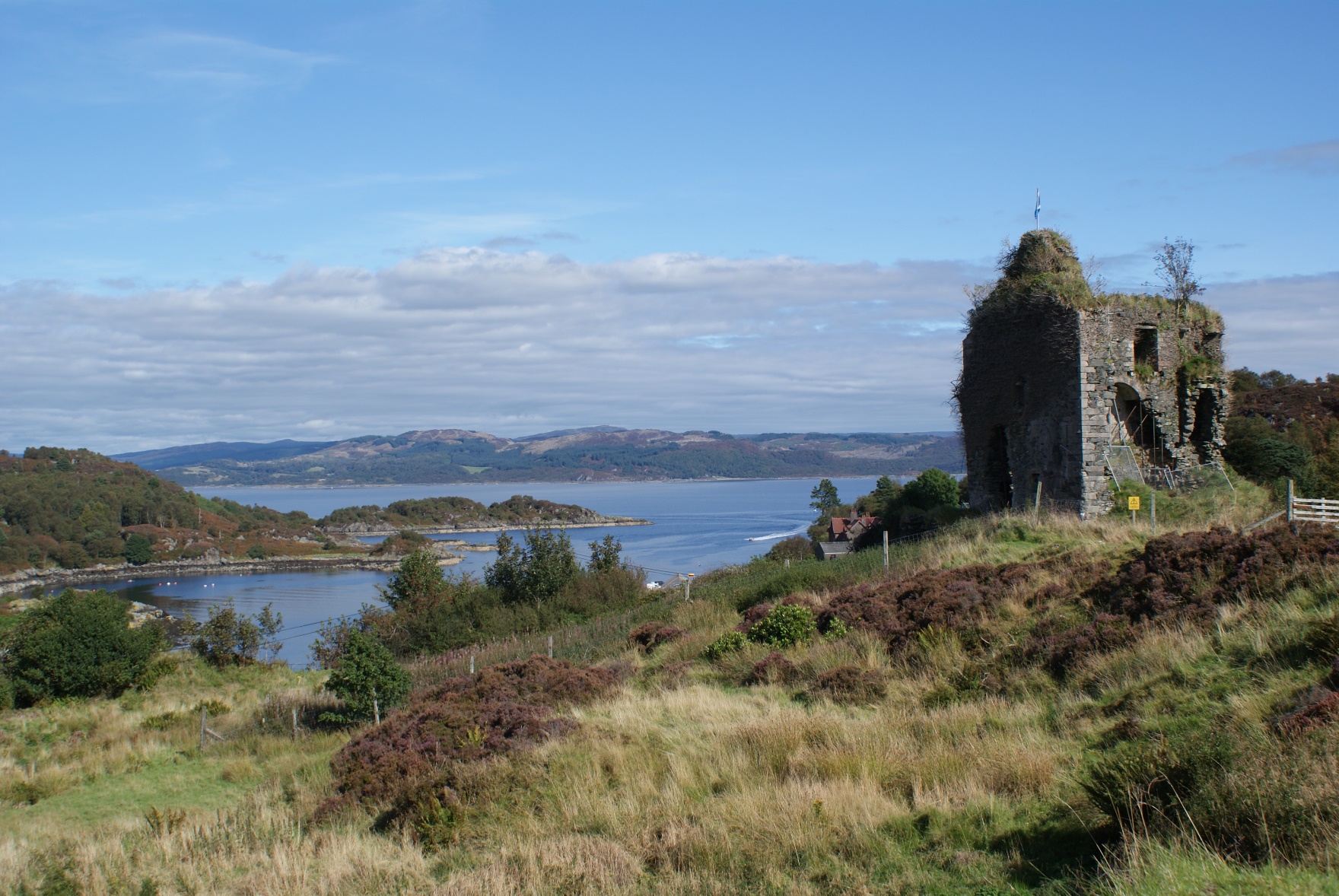
Tarbert Castle, Loch Fyne
Tarbert Castle situated on the shores of Loch Fyne in the historic village of Tarbert holds a significant place in Scotland’s medieval history. The castle’s strategic location on the Kintyre Peninsula allowed control over important trade routes, while its hilltop position offered commanding views of Loch Fyne and the surrounding waters. Built in the 13th century the castle underwent several transformations and expansions over the centuries, most notably under the reign of Robert the Bruce.
Origins and Construction
The earliest parts of Tarbert Castle date back to the late 1200s, though it became more prominent when Robert the Bruce recognized its potential after his victory at the Battle of Bannockburn (see link for the Bruce) in 1314. Understanding the importance of securing Scotland’s western coastlines, Bruce transformed Tarbert into a formidable stronghold. He strengthened its fortifications, expanding the castle to better control access to the Western Isles and protect his interests in the region. As part of Bruce’s grand vision, the castle became a key defensive and administrative center for Scotland’s west coast.
One particularly notable event associated with the castle occurred in **1325** when Bruce had a ship hauled across the narrow isthmus at Tarbert to launch his fleet into **Loch Fyne**, a dramatic display of his naval ambitions and the importance of Tarbert as a military base. This feat, often described as extraordinary, demonstrated the vital role the castle played during Bruce’s reign.
The Role of the Castle in Clan Warfare
After Robert the Bruce’s death, the stronghold of the MacDonalds of Islay, known as the Lords of the Isles—particularly the MacDonald Clan—sought to challenge Scottish royal authority. This led to conflicts, including raids against Tarbert Castle. The MacDonalds had strong ties to the Western Isles and wanted control over the strategic lochside castle.
The castle later fell into the hands of the Campbell Clan one of Scotland’s most powerful families. The Campbells became custodians of Tarbert Castle in the 15th century and under their control, the castle became an essential part of their defensive network, which spanned across the region. The Campbells used Tarbert to secure their influence over Argyll and beyond. It was under the Campbells that the castle saw some of its final modifications and enhancements.
The Jacobite Rebellions and the Castle’s Decline
Tarbert Castle continued to play a vital role in local and national conflicts, particularly during the Jacobite risings of the 18th century During these uprisings, the castle became a government garrison, housing troops loyal to the British Crown. The castle’s strategic importance in these conflicts was again evident, as it was used to help suppress the Jacobite movements that sought to restore the Stuart monarchy.
However, after the final defeat of the Jacobites in 1746 the castle’s importance diminished. With the political situation stabilizing, the castle was gradually abandoned and fell into disrepair. By the 19th century Tarbert Castle was largely in ruins, its military and political relevance having faded. While much of the original structure is no longer standing, the ruins remain a powerful symbol of the area’s historical significance.
Exploring Tarbert Castle Today
Today, visitors can explore the ruins of Tarbert Castle which offer a fascinating glimpse into Scotland’s medieval past. The most prominent remaining structure is the 13th-century keep which still stands tall on the hill, overlooking the village and Loch Fyne Visitors can also see parts of the curtain wall and other remnants of the castle’s fortifications. One of the key highlights of visiting Tarbert Castle is climbing to the top of the hill, where the views of the loch, surrounding hills, and the nearby Cowal Peninsula are breathtaking.
The castle grounds are open to the public year-round, and interpretative signs around the site provide insights into the castle’s history, its role in Scottish politics, and the local clan rivalries that shaped the region. The castle’s ruins, though weathered by time, give a sense of the power and prestige it once held.
Tarbert Castle is also surrounded by walking trails that connect to the village and the Kintyre Way, a popular hiking route that traverses the stunning landscape of the Kintyre Peninsula. The nearby village of Tarbert is itself a picturesque fishing village, with charming streets, historic buildings, and a vibrant local community.
In Conclusion
Tarbert Castle stands as a testament to Scotland’s medieval history, with a rich legacy that includes connections to Robert the Bruce the MacDonalds and the Campbells Though now in ruins, its strategic importance, dramatic setting overlooking **Loch Fyne**, and role in local and national conflicts have left a lasting mark on Scottish history. Visitors today can explore the remains of the castle, learn about its storied past, and enjoy the stunning natural beauty of the surrounding area. With its rich heritage and picturesque location, Tarbert Castle is a must-visit destination for anyone interested in Scotland’s history and the Kintyre region.