Castle Sween: Scotland’s Oldest Standing Stone Castle
Castle Sween, located on the shores of Loch Sween in Argyll, is one of the oldest stone castles in Scotland, dating back to the late 12th century. Built by Sven the Red, a Norse lord, it was later held by the MacSweens, a powerful Scottish family that gave the castle its name (actually, the name Sven and Sween are likely the same and explains the clan Mcsween name and the area names too). The castle’s prime location on the shores of Loch Sween provided strategic control of the surrounding area, making it a valuable stronghold throughout its history.
A Strategic Coastal Stronghold
The castle’s location on the Knapdale Peninsula, with its views over the loch and surrounding hills, offered not only a commanding defensive position but also easy access to the sea. In medieval times, the sea was the primary route for travel and trade, and Castle Sween’s location allowed its occupants to control this vital waterway. The castle’s coastal positioning made it crucial for protecting the western seaboard and served as a powerful symbol of the MacSweens’ dominance in the region.
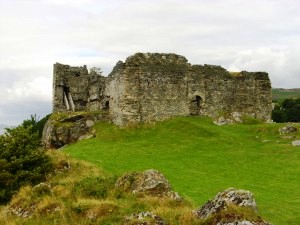
Built in a rectangular layout, Castle Sween’s structure is simple but imposing. The central keep was designed for both defense and residence, with thick stone walls and narrow windows for protection. The ruins still display the remains of its towers, curtain walls, and the central courtyard, offering a glimpse into medieval life. Though the castle is now largely in ruins, the sheer scale of its walls and layout speaks to its former grandeur and significance.
The MacSweens and the Campbell Takeover
Castle Sween remained under the control of the MacSweens for over a century, but their influence waned after the 13th century. The castle passed into the hands of the Stewarts, who later granted it to the Campbells of Loch Awe, one of the most powerful families in Scotland. The Campbells played a major role in shaping the history of Castle Sween, particularly during the turbulent times of clan warfare and rebellion.
The castle’s fortunes fluctuated throughout the centuries. During the Wars of Scottish Independence, Castle Sween was likely involved in the conflicts between the Scottish Crown and the English forces. Over the centuries, it was both a military stronghold and a residence for various noble families, its strategic importance never fully fading until its destruction.
Destruction and Decline
Castle Sween suffered a major blow during the mid-17th century when Alasdair Mac Colla, a notable Scottish-Irish soldier, attacked and burned it during the Wars of the Three Kingdoms, This conflict, which pitted Royalist forces against Scottish Covenanters and the English Parliament, saw the castle heavily damaged, and it was never fully repaired. Following its destruction, Castle Sween fell into disuse, and over time, it became the ruin it is today.
Despite its ruinous state, Castle Sween remains a historically significant landmark. Its surviving walls and towers are a testament to its medieval origins and the important role it played in Scottish history. Today, it stands as one of the most atmospheric ruins in the region, with its backdrop of Loch Sween and the surrounding hills offering a sense of the isolation and grandeur of the site.
Visiting Castle Sween
Visitors to Castle Sween are treated to more than just a history lesson. The location, nestled between the loch and rolling hills, offers a stunning landscape perfect for exploring. The castle is easily accessible, with parking nearby, and offers visitors the opportunity to wander through the ruins, take in the scenery, and imagine the lives of those who once called it home.
The surrounding area is rich in natural beauty and historical significance, with nearby attractions including Knapdale Forest, famous for its wildlife and Scottish beavers, and the Crinan Canal, a popular spot for boating and cycling. The peaceful environment around Castle Sween contrasts with its turbulent past, offering a quiet retreat for those interested in both history and nature.
Castle Sween is not just a ruin; it is a symbol of Scotland’s medieval past and the changing fortunes of its ruling clans. From its construction by the MacSweens to its capture by the Campbells, the castle’s history is deeply intertwined with the power struggles that shaped the west of Scotland. Its strategic coastal location made it an essential stronghold, and although it now stands in ruins, its grandeur and importance endure.
For visitors, Castle Sween offers a unique combination of historical exploration and scenic beauty. The towering walls, rugged landscape, and views over Loch Sween provide a perfect backdrop for immersing yourself in Scotland’s medieval past, making it a must-visit destination for history buffs and nature lovers alike.