Dunollie Castle, Oban
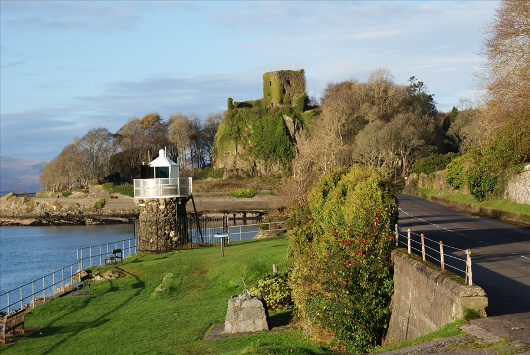
Dunollie Castle, perched on a rocky promontory overlooking Oban Bay, is a historic ruin with a rich heritage that dates back to the 12th century. The castle has long been the ancestral home of the Clan MacDougall, who were influential in the Western Highlands of Scotland. Built on a site that had been occupied since at least the Iron Age, Dunollie played a key defensive role in controlling access to the Firth of Lorn and the surrounding islands.
Early History and Construction
The site of Dunollie Castle has been used for defensive purposes for centuries. The earliest fortifications likely date back to 600 AD, but it was during the 12th century that the MacDougalls established the stone structure that still partially stands today. Positioned strategically on high ground, the castle had commanding views over Oban Bay, allowing its occupants to monitor and control maritime traffic between the mainland and the Hebrides. Dunollie Castle was the seat of power for the Lords of Lorn, the title held by the MacDougall Clan. The castle was expanded and fortified over time, with its tower house being one of the key features, offering protection and residence for the clan's leaders. The site also played a significant role during the Wars of Scottish Independence, with the MacDougalls initially supporting King John Balliol in opposition to Robert the Bruce.
The MacDougall Clan's fortunes took a turn for the worse after Robert the Bruce came to power, following his victory at the Battle of Bannockburn in 1314. As former allies of his enemies, the MacDougalls were stripped of much of their land and influence, though they retained Dunollie Castle as their ancestral seat. Over the following centuries, the castle remained a key part of the clan’s holdings, but it eventually fell into disrepair.
In the 17th century, the MacDougalls built Dunollie House, a more comfortable residence located a short distance from the original castle. As the family moved into the new house, the castle was largely abandoned, and over time it deteriorated into the ruin that visitors see today. Despite this decline, the castle remains an important symbol of the clan’s legacy in the region.
Role in Scottish History
Though much of Dunollie Castle’s physical structure has been lost to time, its role in Scottish history remains significant. The MacDougalls’ complex relationship with the Crown of Scotland and their involvement in the Wars of Scottish Independence meant that Dunollie was a focal point during key moments of conflict in the Highlands. The castle’s strategic location made it a valuable stronghold, and its ruins still evoke the long history of clan rivalry and warfare in the region.
Dunollie’s location also gave it importance during the Jacobite Rebellions in the 18th century. Though the MacDougalls did not play a major role in the uprisings, the castle would have witnessed the movement of troops and supplies through the waters around Oban.
Visiting Dunollie Castle Today
Today, Dunollie Castle is open to visitors, who can explore the ruins and the surrounding grounds. The castle’s elevated position offers stunning views of Oban Bay, the Isle of Kerrera, and beyond to the Inner Hebrides. Though much of the castle has crumbled over the centuries, the remnants of the tower house and curtain walls give a sense of its former scale and strength.
Adjacent to the castle ruins is Dunollie Museum, Castle, and Grounds, where visitors can learn more about the MacDougall Clan and the history of the castle. The museum houses artifacts from the clan’s past and provides insight into the history of the castle and its surrounding lands. The site also offers woodland walks, a heritage garden, and regular events that celebrate Highland culture and history.
Dunollie Castle is not just a historical site; it is a symbol of the resilience and tenacity of the MacDougall Clan and the complex history of the Western Highlands. Visitors who explore its ruins can step back in time and experience the atmosphere of an ancient stronghold that once played a pivotal role in the defense of Scotland’s western shores.
In Conclusion
Dunollie Castle’s long history, dating back to ancient times, makes it one of the most significant sites in the Oban area. Though now a ruin, it remains a symbol of the MacDougall Clan and their influence over the Western Highlands. The castle's strategic location, commanding views, and rich history make it a must-visit for anyone interested in Scotland’s medieval past. Exploring Dunollie Castle and its surrounding grounds offers an unforgettable experience, where the history of Scotland and the beauty of the Highlands come together.