Dunivaig Castle, Isle of Islay
Dunivaig Castle, located on the southeastern coast of the Isle of Islay, is a historic ruin with a dramatic history that ties it to the power struggles of the Scottish Highlands. Once the stronghold of the MacDonalds of Islay, known as the Lords of the Isles, Dunivaig played a central role in the maritime defense of the island and the surrounding Hebrides. Overlooking the sheltered waters of Lagavulin Bay, the castle’s strategic location made it an ideal base for controlling access to the surrounding sea routes and protecting the western Scottish coast.
Early History and Construction
Dunivaig Castle was originally built in the 13th century as a fortified keep, strategically positioned to oversee the North Channel, the passage between Scotland and Northern Ireland. The castle’s design was typical of the medieval period, featuring thick stone walls, battlements, and narrow windows for defense. The position of Dunivaig on a rocky promontory, jutting out into the bay, gave it natural protection on three sides, making it a difficult target for attackers.
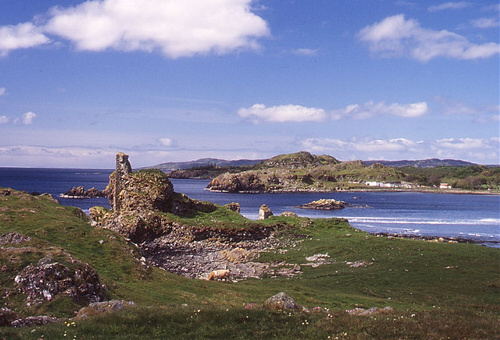
Photograph by Tom Richardson
As the principal seat of the MacDonald Clan, Dunivaig became a symbol of their power and influence across the western seaboard. The MacDonalds were one of the most powerful clans in Scotland, ruling a maritime kingdom that spanned from the Hebrides to the west coast of Ireland. Dunivaig’s role as a naval stronghold allowed the clan to project its power across the sea, dominating trade routes and providing a base for launching both defensive and offensive actions against rivals.
Role in the Wars of Scottish Independence
During the Wars of Scottish Independence, Dunivaig Castle was an important asset in the struggles between England and Scotland. The MacDonalds, initially siding with the English, later shifted their allegiance to Robert the Bruce, supporting his claim to the Scottish throne. This strategic alliance helped secure Dunivaig’s status as a critical naval base in the ongoing conflict. The castle’s defenses were strengthened during this period, and it played a key role in the MacDonalds’ ability to maintain control of Islay and its surrounding waters.
Decline and Conflict with the Campbells
Like many castles in the Highlands, Dunivaig’s history is marked by conflict and shifting allegiances. In the 16th and 17th centuries, the MacDonalds' hold on the castle began to wane as the rival Clan Campbell grew in power. The Campbells, staunch supporters of the Scottish Crown, gradually took control of much of the MacDonald territory, including Islay.
Dunivaig Castle became a focal point in the violent struggles between the two clans. The castle was captured and recaptured multiple times during this period, with both sides vying for control of the valuable stronghold. The Campbells eventually succeeded in seizing Dunivaig, leading to the decline of the MacDonalds’ influence on Islay. In the 1600s, Sir John Campbell of Cawdor was granted control of Islay, further solidifying the Campbells’ dominance over the island.
Dunivaig and the Wars of the Three Kingdoms
Dunivaig Castle’s importance extended into the Wars of the Three Kingdoms in the mid-17th century, a series of civil wars that engulfed Scotland, Ireland, and England. The castle was once again a site of conflict, changing hands between Royalist and Covenanter forces. In 1647, Archibald Campbell, the 1st Marquess of Argyll, laid siege to the castle, eventually capturing it from Royalist forces loyal to King Charles I. After this, the castle was significantly damaged, marking the beginning of its decline.
Dunivaig Castle in Ruins
By the late 17th century, Dunivaig Castle had fallen into ruin. The castle’s strategic importance diminished with the rise of more centralized power under the Scottish Crown, and the growing strength of the Campbells rendered the MacDonalds' attempts to reclaim their former stronghold futile. Without regular maintenance and with the scars of numerous battles weakening its structure, Dunivaig gradually decayed, leaving behind the atmospheric ruins that still stand today.
Today, visitors to Islay can explore the ruins of Dunivaig Castle and imagine its former grandeur. Though much of the castle has crumbled over the centuries, its position overlooking Lagavulin Bay remains as breathtaking as ever. The ruins, though weathered, still hold traces of its once-imposing presence, and the surrounding landscape, including the famous Lagavulin Distillery, offers a fascinating juxtaposition of ancient history and modern industry.
Visiting Dunivaig Castle Today
For those visiting Islay, Dunivaig Castle is an essential stop. The castle’s ruins are accessible via a coastal path from the nearby Lagavulin Distillery, providing a scenic walk along the rugged shoreline. The site offers stunning views over the bay, and the quiet isolation of the ruins gives visitors a sense of the castle’s historical importance.
Though the castle is now just a shadow of its former self, the experience of standing on the promontory, looking out over the sea, provides a powerful connection to Scotland’s medieval past. Dunivaig Castle remains a symbol of the once-mighty MacDonald Clan and their influence on Scotland’s western seaboard. Visitors can explore the site and reflect on the centuries of conflict, power, and intrigue that shaped not only the castle but the history of Islay and the surrounding Hebrides.
Conclusion
Dunivaig Castle stands as a testament to the MacDonalds' maritime prowess and the turbulent history of Scotland’s west coast. While its physical structure may have crumbled over time, the castle’s historical significance endures, offering visitors a glimpse into the power struggles and conflicts that shaped the region. With its breathtaking views and rich history, Dunivaig Castle remains a must-see for anyone exploring the Isle of Islay, where the echoes of Scotland’s past can still be felt in every stone.