Dunstaffnage Castle, near Oban
Dunstaffnage Castle, located near Oban, is one of Scotland’s oldest and most significant fortifications, with origins dating back to the 13th century. Built by the powerful Clan MacDougall, the castle played a central role in the political and military history of the Western Highlands. Perched on a rocky promontory overlooking the Firth of Lorn, the castle’s location allowed control of important sea routes and access to the Inner Hebrides.
Early History and Construction
The castle was built on a site of strategic importance. The promontory on which it sits had been occupied long before the castle was constructed, likely since the Iron Age, and it provided an ideal defensive location. Its position allowed control over the vital maritime routes leading to and from the Hebrides, which were essential for trade and defense in medieval times. The stone structure of Dunstaffnage, with its thick curtain walls and towering round towers, was built by Duncan MacDougall, son of Somerled, the legendary Norse-Gaelic ruler who laid the foundation for the power of the Lords of the Isles.
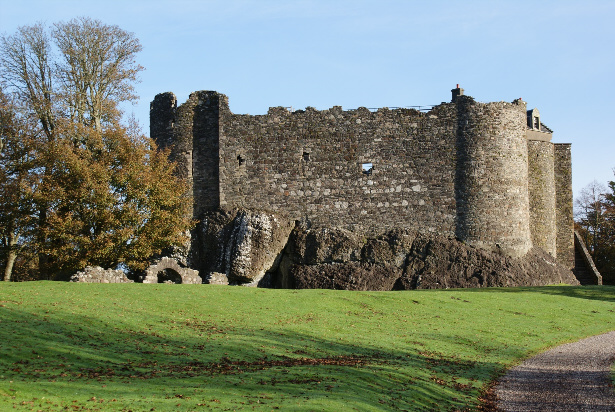
Dunstaffnage became a power base for the MacDougalls of Lorn, who held significant influence in the region. However, after the Wars of Scottish Independence, the MacDougalls, who had supported the defeated King John Balliol and the English, were ousted by Robert the Bruce. Dunstaffnage Castle was seized by the Crown and passed into the hands of the Campbells, one of the most powerful clans in Scotland.
The Campbells and Later History
The Campbell Clan held Dunstaffnage for several centuries, using it as a residence and military base. The castle remained strategically important as the Campbells consolidated their power in the Highlands. The 15th century saw several modifications and additions to the castle, including the construction of the gatehouse and other domestic buildings within the castle walls.
In the 16th century, Dunstaffnage played a role in the violent conflicts between clans, including skirmishes and sieges. It also became a royal prison on several occasions. Most famously, Flora MacDonald, who helped Bonnie Prince Charlie escape after the failed Jacobite Rising of 1745, was briefly imprisoned in Dunstaffnage Castle before being transferred to the Tower of London.
By the 18th century, the castle’s military importance had declined, and it was partially abandoned. However, the Campbells of Dunstaffnage continued to reside in the nearby Dunstaffnage House, and the castle remained a symbol of their ancestral power.
Dunstaffnage Castle Today
Today, Dunstaffnage Castle is managed by Historic Environment Scotland and is open to the public. Visitors can explore the castle’s ruins, which include the great hall, the round towers, and the gatehouse, all of which offer a glimpse into Scotland’s medieval past. The castle’s position on the coast provides stunning views over the Firth of Lorn and nearby islands.
Adjacent to the castle is Dunstaffnage Chapel, a 13th-century ruin that adds to the historical ambiance of the site. The chapel was likely used by the castle’s occupants for religious services and stands as a testament to the importance of faith in medieval life.
Walking through the ruins, visitors can imagine the strategic importance of the castle during its heyday and reflect on its role in shaping the history of the Scottish Highlands. With its combination of military history and scenic beauty, Dunstaffnage Castle remains a must-visit destination for anyone exploring Argyll and the Western Isles.
In Conclusion
Dunstaffnage Castle, with its commanding location on the shores of the Firth of Lorn, is a symbol of the turbulent history of Scotland’s West Coast. From its construction by the MacDougalls to its centuries under the Campbells, the castle has played a key role in Scotland’s medieval and early modern history. Today, it stands as a reminder of the region’s strategic importance and offers visitors a unique opportunity to connect with Scotland’s rich past.